50 Things To Keep Kids Busy On A Long Flight And Avoid Mid-Air Meltdowns
Knowing how to keep kids busy on a long flight helps you plan ahead instead of reacting to boredom mid-flight. These 50 ideas give you practical options for toddlers, school-age kids, and tweens without turning your carry-on into a toy box.
Author:Michael RachalReviewer:Finn WildeMay 22, 20261.5K Shares84.5K Views
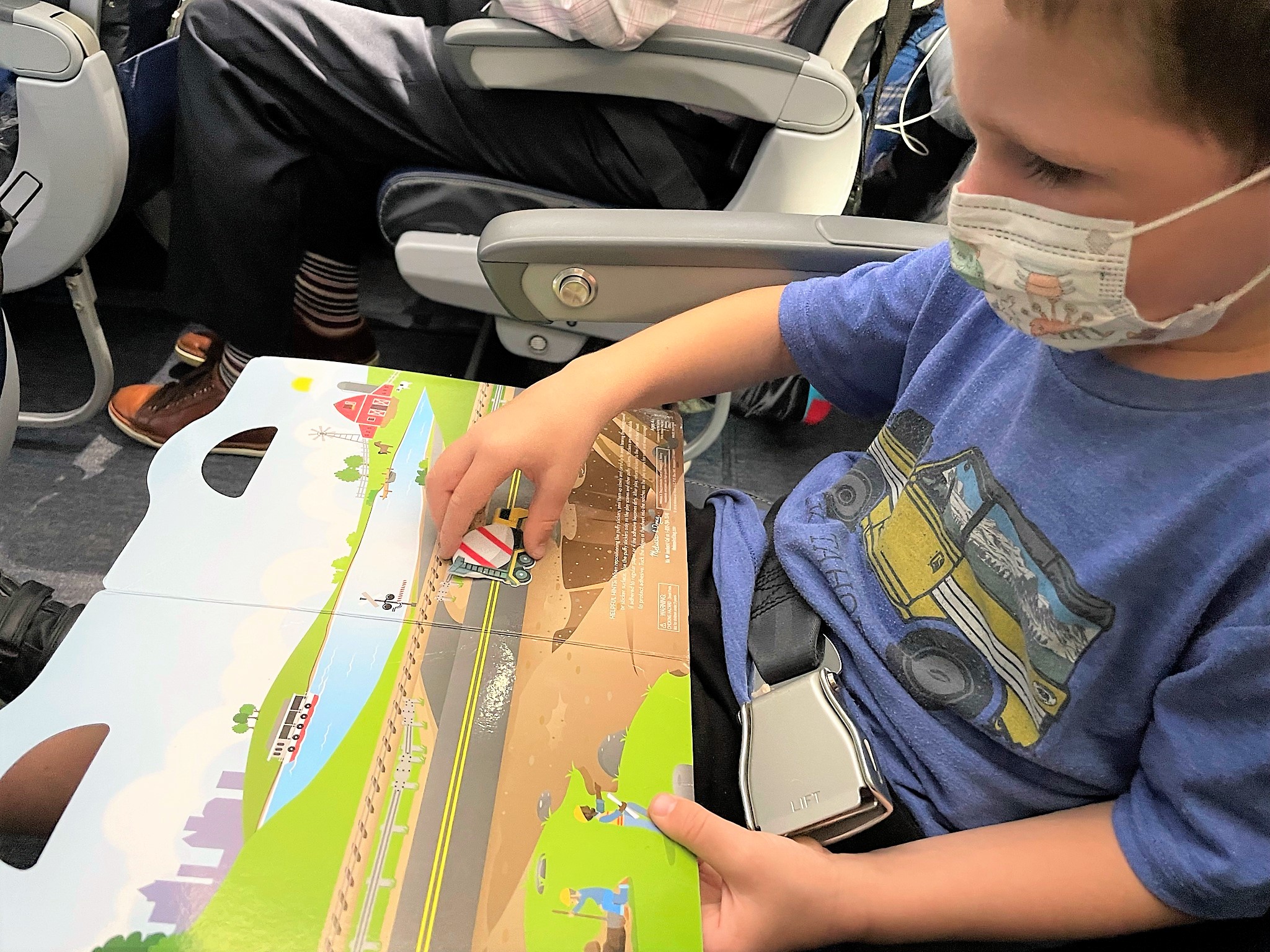
The most important thing to know before packing a single activity is that rotation beats quantity. A child given access to everything at once will be bored within an hour. A child who receives one new item every 30 to 45 minutes stays engaged across an entire long-haul flight.
Screen time is completely acceptable on a flight. Travel is a context where normal screen limits can flex, and a preloaded tablet is one of the most reliable tools a parent can carry. The strategy is to save it for the middle or later portion of the flight, not the first hour. The 50 activities below are organized so parents can quickly find what suits their child's developmental stage, then build a packing plan around flight length.
What This Article Covers
- A full list of 50 specific, up-to-date activities with current product names and practical notes for each one
- An age-by-age guide mapping each activity to toddlers, early childhood, and older kids
- A packing framework based on flight duration, so parents know exactly how many items to bring
- The surprise bag strategy is explained step by step, including how to time reveals across a 10-hour flight
- A clear list of what not to bring, and why certain popular ideas fall apart in a cramped airplane seat
Why The Rotation Principle Changes Everything
Most parents instinctively hand over the activity bag at boarding and let a child sort through it. That approach burns through novelty in the first 90 minutes and leaves several hours of flight with nothing new to offer.
The rotation principle works differently. One item comes out at a time. When engagement starts to drop, that item goes away, and the next one appears. This single shift extends a five-item pack into four or five hours of meaningful entertainment without buying more stuff.
A good working guide for pack size based on flight duration:
- Under 3 hours:2 to 3 activities plus snacks
- 3 to 7 hours:4 to 6 activities with one rotation per hour
- 8 to 14 hours:7 to 10 activities structured as a timed surprise bag, plus a tablet loaded and ready
Screens are most effective in the second half of a long flight, once the novelty of physical activities has started to fade naturally. Saving the tablet for hours four through eight of a 10-hour flight is a far better strategy than opening it.
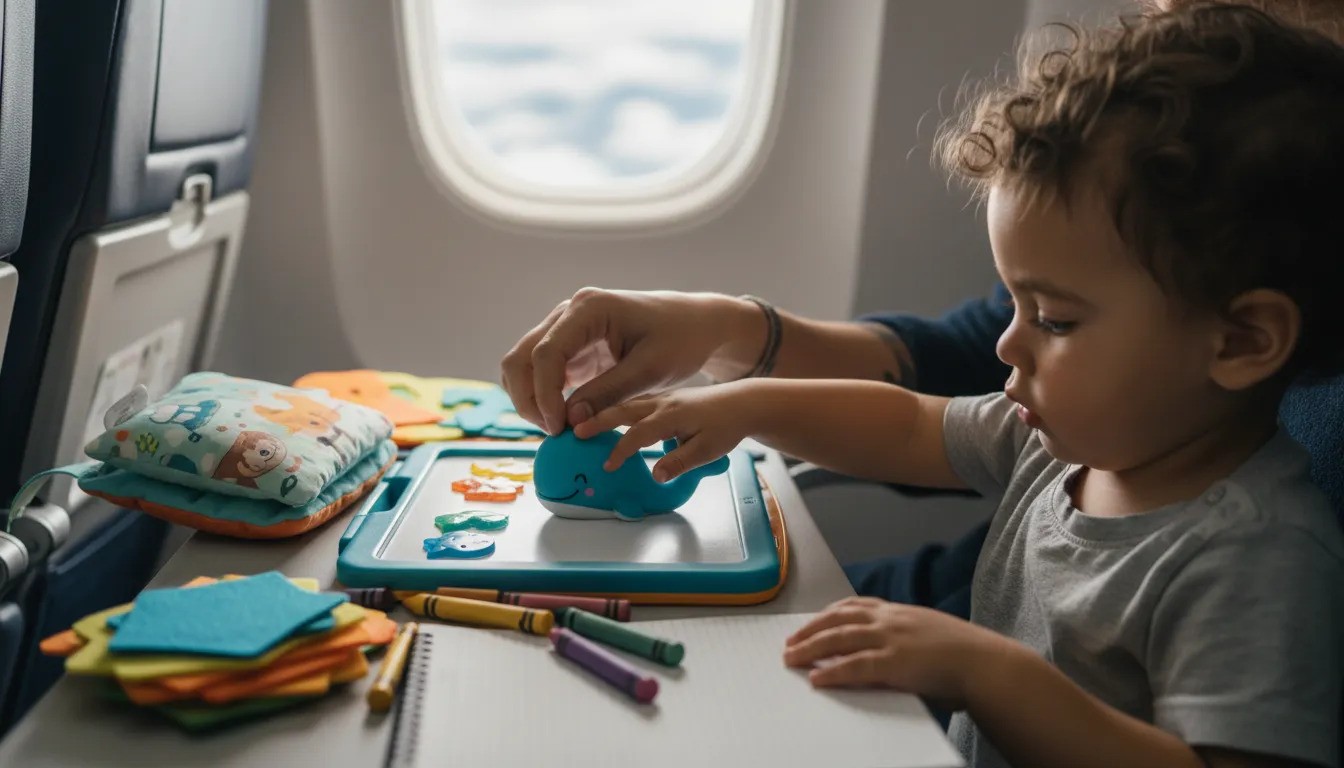
Hands-On Sensory And Sticker Activities
These activities suit ages 2 through 6 best and are the backbone of any toddler flight kit. They require no table space, create no mess, and engage fine motor skills in ways that genuinely absorb young children.
1. Window Clings
Window clings peel on and off the airplane window repeatedly without leaving marks or residue. They are one of the most consistently recommended toddler flight activities for good reason.
Themed sets such as sea creatures, farm animals, or holiday scenes are widely available at dollar stores and on Amazon for under $5 per pack. A child can spend 45 minutes to an hour arranging and rearranging the same set. Pack two or three different theme packs and rotate them.
2. Reusable Sticker Books With Scene Pages
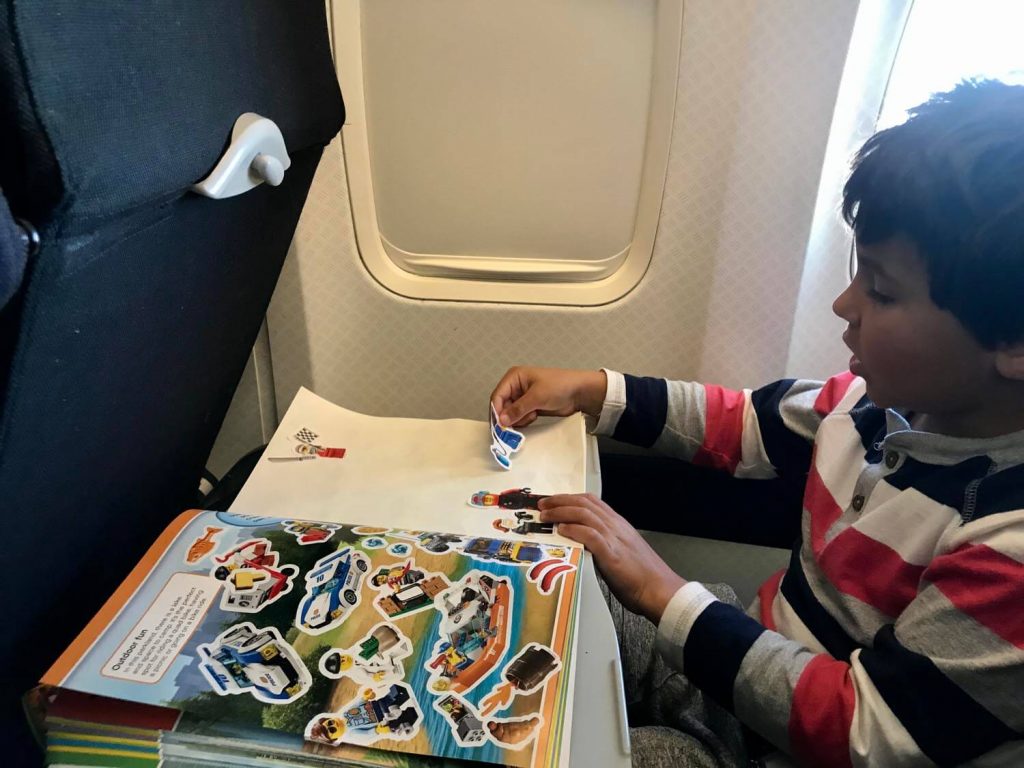
These are different from standard sticker books. Scene-based sticker books such as the Melissa & Doug Puffy Sticker Play Sets give children a backdrop, like a farm or a zoo, and a full sheet of repositionable stickers to populate it. Because the stickers lift off and go back on, the book does not get "used up" and can run across multiple sittings during the flight.
3. Water Painting Books (Water Wow Style)
The Melissa & Doug Water Wowseries uses a refillable water pen to activate color on the page. No paint, no mess, no markers without caps rolling under the seat. The pages dry clear within minutes and can be painted again. The Travel Water Wow pads are sized specifically for a tray table and come in themes including animals, vehicles, alphabet, and numbers. Best for ages 3 to 7.
4. Lacing Cards
Lacing cards involve threading a shoelace or cord through holes in a stiff illustrated card. They build fine motor skills, require complete focus, and create zero mess. The Wee Gallery Lacing Cards feature high-contrast animal illustrations that appeal to toddlers and preschoolers. Each card keeps a child occupied for 10 to 20 minutes per session, and the set is light and flat enough to slip into any carry-on pocket.
5. Finger Puppets
A set of 10 finger puppets in a small zip pouch weighs almost nothing and takes up less space than a paperback book. A parent can use them to act out a simple story, and older toddlers will quickly take over the performance themselves. Folkmanis and Melissa & Doug both make current sets organized by theme, including jungle animals, sea creatures, and fairytale characters.
6. Suction Spinner Toy
The Mushie Sunshine Suction Spinner attaches to the airplane tray table or window via a suction cup and spins freely. Babies and young toddlers find the spinning motion highly engaging. Because it is attached to the surface, it cannot fall to the floor or get lost between seats, which is a significant practical advantage at altitude.
7. Pipe Cleaners
A small bundle of colorful pipe cleaners costs almost nothing and can be twisted into dozens of shapes. Children aged 3 and up can make letters, animals, bracelets, and abstract sculptures.
There are no loose pieces, no mess, and no noise. When a shape is done, it gets bent back into a new one. One bundle of 50 mixed-color pipe cleaners can occupy a creative child for well over an hour across a long flight.
8. Playdough In A Sealed Mini Container
A single mini Hasbro Play-Doh container (the 1-ounce size, widely available in multipacks) is enough for a flight session without creating a cleanup situation. Keep it to one color at a time and place it on the tray table with a placemat underneath.
Best for ages 3 to 5. It is worth noting that some airline policies restrict strong-smelling items in enclosed cabins, so a scent-free option such as Crayola Air-Dry Clay is an alternative.
9. Painter's Tape
A small roll of painter's tape is a genuinely underrated flight toy. It sticks to airplane surfaces, including tray tables, armrests, and seat-back fabric, without leaving marks. A parent can create a simple road for a toy car, stick small toys to the window for a "rescue" game, or let a toddler peel off strips independently, which is itself a highly engaging fine motor task for children aged 2 to 4.
10. Stackable Sensory Cups
Soft silicone stacking cups, such as the Munchkin Caterpillar Spillers or the Marcus & Marcus Stacking Cups, are flexible, lightweight, and completely safe. They nest flat for packing and expand into a stackable set during the flight. Young toddlers aged 18 months to 3 years will stack, knock over, and restack these for longer than most parents expect.
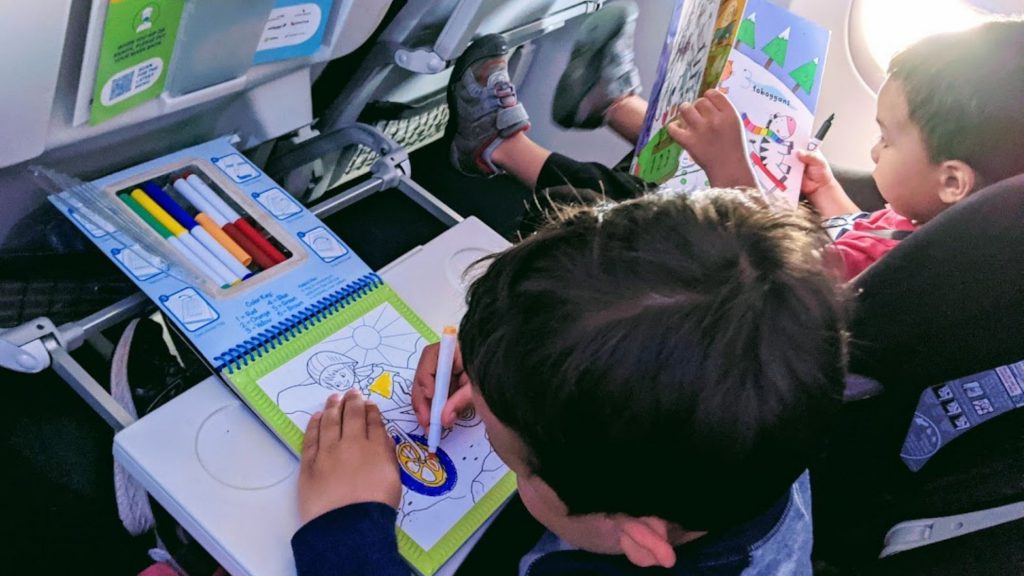
Drawing, Writing, And Creative Activities
This category works across a wide age range. Children aged 4 and up can engage with drawing independently, and the activities below are specifically chosen for tray-table compatibility.
11. Small Spiral Sketch Pad With Plain Paper
Lined paper is the wrong choice for a flight. Plain, unlined paper gives children maximum freedom. A 5x7-inch spiral sketch pad fits on a tray table without overlapping onto a neighboring seat. Combined with a small pouch of drawing tools, this is the activity that most consistently holds attention across the widest age range, from 4-year-olds drawing animals to 11-year-olds designing comic panels.
12. LCD Drawing Tablet
The Boogie Board Jot 8.5 is the current market-leading option. It is slim, weighs under 200 grams, and uses pressure-sensitive writing that erases with a single button. There are no caps, no ink, no crumbs, and no mess. Children use it for drawing, writing games, scorekeeping for card games, tic-tac-toe, and dot-to-dot patterns. Battery life runs to thousands of hours and does not require charging between flights.
13. Coloring Books
Standard coloring books remain one of the simplest and most reliable flight activities for children aged 3 through 8. For older children, the Johanna Basford junior editions and the Usborne Big Book of Doodles provide more complex images that feel less babyish. Bring a small zipper pouch with 6 to 8 colored pencils rather than a full set. Retractable colored pencils eliminate the cap-loss problem.
14. Travel Journal
For children aged 7 and up, a small blank or dotted journal (A6 size works best on a tray table) becomes a record of the trip. Children draw what they see from the window, note how long the flight is, paste in their boarding pass stub, and sketch the meal tray. The Leuchtturm1917 Pocket notebook in A6 is a current popular choice and is robust enough to last the full trip.
15. Origami
A beginner origami kit includes pre-cut square paper in multiple colors and a simple illustrated instruction sheet. The Tuttle Publishing Origami for Beginners kit is widely available and includes 96 sheets with printed patterns and a booklet of 20 simple projects.
Children aged 6 and up can follow the diagrams independently. Younger children will need guidance. Completed pieces can be lined up on the tray table or stored in a small envelope.
16. Dry-erase Activity Books
Dry-erase workbooks such as the School Zone Big Preschool Workbook in wipe-clean format allow children to complete puzzles, tracing, and mazes, and then erase and redo them. A single book can run across multiple flights. Best for ages 4 to 7. Pack one dry-erase marker rather than a set, and clip it to the book cover to prevent it from rolling away.
17. Mess-free Magic Pen Activity Sets
The Crayola Color Wonder range uses special markers that only activate on the proprietary paper, meaning they produce zero color on skin, clothing, or seat fabric. Current sets include themes covering dinosaurs, Disney characters, superheroes, and space. They are widely available in both travel and standard sizes and are one of the most practical mess-free drawing options for ages 3 to 7.
18. Sticky Note Art
A small pad of Post-it notes and a pencil or marker gives children aged 4 and up a compact, creative outlet. They can draw on each note and stick it to the seat-back tray or the window. A parent traveling with a 6-year-old on a long overnight flight might find that a simple challenge, such as drawing one animal per note until the pad runs out, occupies a solid 30 to 40 minutes with no setup required.
19. Printable Activity Sheets
Printed before departure, a small folder of airplane-themed activity sheets, including I-spy grids, word searches, drawing prompts, and simple crosswords, costs nothing and weighs nothing. Free resources are available from sites including Twinkl and Activity Village. Print 8 to 10 sheets, staple them together, and introduce one at a time during the flight. Best for ages 5 through 10.
20. Drawing What Is Visible Through The Window
This is not a purchased product but a prompted activity. A parent traveling with a 7-year-old can open the window shade and ask the child to draw exactly what they see: cloud formations, the wing, the engine casing, the horizon line. The specificity of the task creates focus that free drawing sometimes does not. It works particularly well during descent, when the landscape below becomes recognizable and interesting.
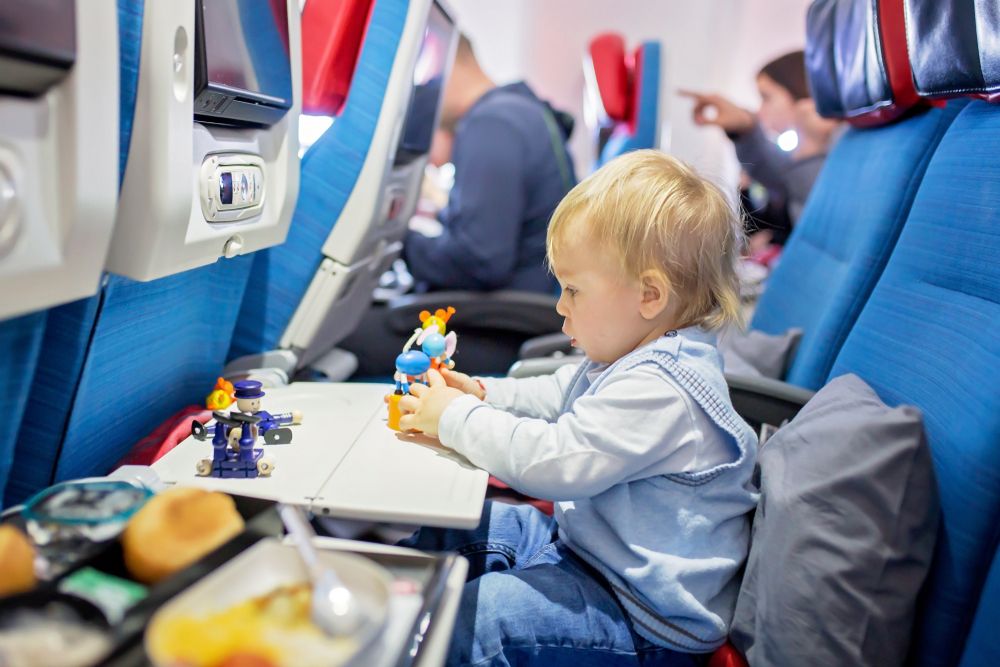
Games, Puzzles, And Strategy Activities
These activities suit ages 6 and up and provide the longest individual engagement windows of any category in this list.
21. Kanoodle
Kanoodle by Educational Insights is a single-player puzzle game in which 12 colored pieces must fit into a tray grid using a provided puzzle card. The self-contained case holds all pieces and 200 puzzle challenges across four difficulty levels. The entire unit is smaller than a hardcover book and produces no loose pieces. It is one of the most dependable long-engagement activities for ages 7 through adulthood.
22. Kanoodle Genius
The step-up version of Kanoodle, Kanoodle Genius, uses 3D puzzle configurations and is specifically suited to children aged 8 and up who find standard Kanoodle too easy. The case is even smaller than the original and fits in a jacket pocket. The tactile feedback of clicking pieces into place is satisfying enough that many parents end up doing these puzzles themselves.
23. Rubik's Cube
The standard 3x3 Rubik's Cube or the smaller Rubik's Mini (2x2) keeps hands occupied without generating any mess or noise. A child who already knows how to solve it will work through it repeatedly. A child who does not will tinker with it for surprisingly long stretches regardless. Current Rubik's-brand cubes use a smooth, updated mechanism that turns more easily than older versions and is less frustrating for younger solvers.
24. Mini Magnetic Chess
Travel magnetic chess sets, such as the WE Games Magnetic Chess Set (10-inch folding board), keep pieces in place during turbulence and store flat when not in use. Chess suits children aged 7 and up who enjoy strategy and can run across an entire long-haul flight, for older children who are genuinely invested in the game. For siblings, it doubles as an in-flight competition.
25. Travel Magna-Tiles
Magna-Tiles released a dedicated travel set in 2024 that uses smaller tiles in a compact tin case. Unlike standard Magna-Tiles, which require floor or table space to build effectively, the travel edition is designed for tray-table surfaces. Children aged 4 through 9 consistently engage with magnetic building sets, and the self-contained storage means no pieces scatter during turbulence.
26. Magnetic Stickmen
Playlearn Magnetic Stickmen (also sold as Magnetic Men) are flexible stick figures that can be bent, posed, and connected. They stick to each other and to metal surfaces, including seat-back frames. There is no right way to play with them, which means they hold attention differently each session. They suit ages 3 through 9 and are frequently cited by long-haul traveling families as one of the highest-value items in a flight bag.
27. Hidden Picture Books
Highlights Hidden Pictures Puzzles books present detailed illustrated scenes in which specific objects are hidden. Children aged 4 through 8 can work through them independently for extended periods. The current Highlights Travel Activity Pads are spiral-bound, tray-table-sized, and include hidden picture puzzles alongside dot-to-dots and mazes in a single compact volume.
28. Maze And Dot-to-dot Books
A dedicated maze book, such as the Usborne Big Book of Mazes or the Dover Publications Kids Maze Activity Book, provides deep-focus engagement for ages 6 through 10. Complex mazes require sustained concentration and create a satisfying sense of completion when finished. Dot-to-dot books for older children, including the Thomas Pavitte 1000 Dot-to-Dot series, engage children aged 9 and up for considerably longer than simpler versions.
29. Brain Teaser And Logic Puzzle Books
For children aged 8 and up, books such as the Mensa Kids Train Your Brain series or the Mindware Brain Boosters provide logic grids, pattern puzzles, and lateral thinking challenges. These feel grown-up rather than childish, which matters enormously to older elementary children. A single volume holds enough puzzles to occupy an engaged child across a full transatlantic flight.
30. Mini Simon Game
The Hasbro Mini Simon game is a palm-sized version of the classic memory sequence game. It operates in solo mode, requires no opponents, and runs on two AAA batteries. The light-and-sound sequence challenges increase in complexity with each successful round. At roughly the size of a hockey puck, it fits into any pocket and suits children aged 5 through 12.
Card Games And Group Activities
Card games create shared moments that individual activities cannot. They work best for siblings or for a parent and child playing together.
31. UNO (tin Version)
The Mattel UNO tin stores cards in a metal container that holds form far better than the standard cardboard box, meaning it survives being pulled in and out of a bag repeatedly across a multi-leg journey. UNO suits ages 5 and up, requires minimal tray table space, and scales from two to four players. The rules are simple enough for younger children but varied enough to stay interesting for older ones.
32. Spot It (Dobble)
Spot It by Asmodee is a fast-matching card game in which every pair of cards in the circular deck shares exactly one symbol. Rounds last two to three minutes, reset instantly, and suit ages 4 through adult. The compact tin is airport-security friendly and weighs under 100 grams. Multiple game modes are printed inside the tin lid, so the experience can be varied across a long flight.
33. Mad Libs
Mad Libs travel editions by Price Stern Sloan are small enough to fit in a back pocket. One child asks for words while another fills in the blanks, producing absurd sentences that reliably generate laughter among siblings. The activity teaches parts of speech without feeling educational. Travel-specific editions, including the aptly titled "Road Trip Mad Libs," feature travel and airplane scenarios throughout.
34. Standard Card Deck (multiple Games)
A single standard 52-card deck supports Go Fish, Snap, War, Crazy Eights, and Slapjack without requiring any rulebook. Current Bicycle Rider Back playing cards come in a slim plastic case that prevents bending across a long trip. For younger children aged 3 to 5, a Go Fish deck using illustrated animal cards, such as the Eeboo Go Fish set, is a better fit than a standard deck.
35. Cat's Cradle
Cat's Cradle requires only a single loop of string and a willingness to learn a few hand patterns. It takes up zero packing space, produces zero mess, and works in the most cramped economy class seat.
A parent who knows two or three basic patterns can teach them progressively to a child aged 5 and up, which stretches a single piece of string into 20 to 30 minutes of engaged play. Tutorial cards are available from Klutz, which publishes a Cat's Cradle kit with string and illustrated step cards.
36. Printable Airplane Bingo
Printed before departure, airplane bingo cards challenge children to spot items in the cabin and visible from the window, including the seatbelt sign, a flight attendant with a cart, clouds shaped like animals, and the in-flight map. Free printable versions are available from numerous family travel blogs and can be printed at home in five minutes. Best for ages 4 through 9, and particularly effective during boarding and the first 30 minutes of flight.
Audio And Screen Activities
These activities carry the heaviest entertainment load on very long flights. The strategy is not to avoid them but to deploy them at the right moment.
37. Pre-downloaded Movies And Shows
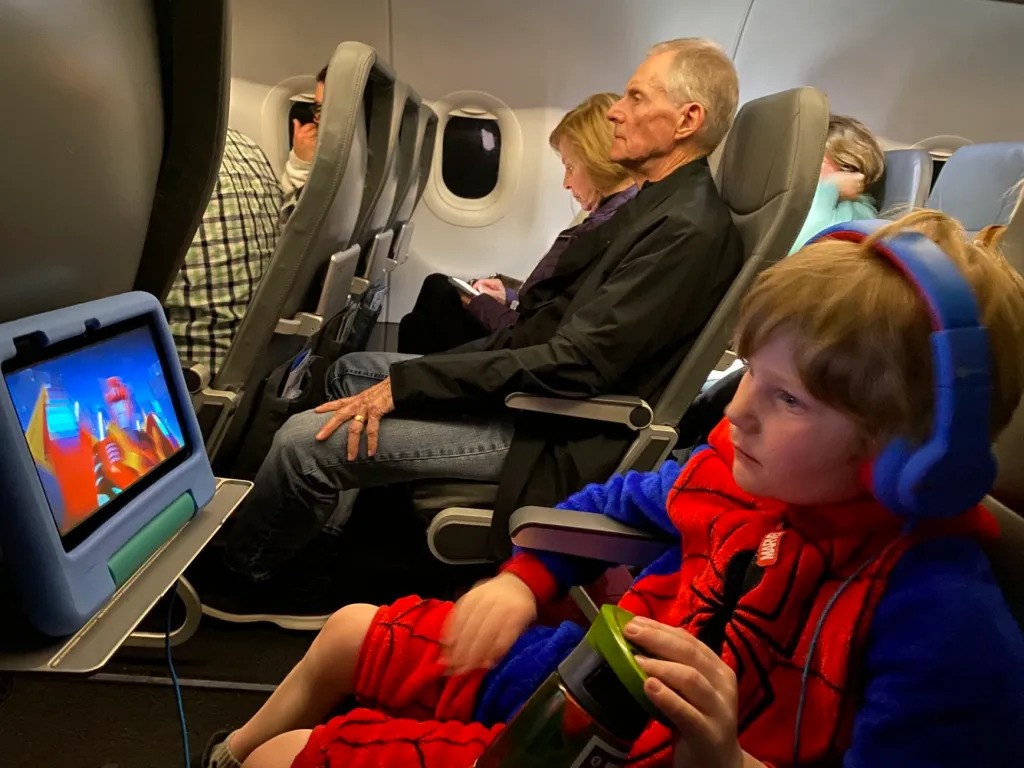
Netflix, Disney+, Amazon Prime Video, and Apple TV all support offline downloads to mobile devices and tablets. Before any long flight, a parent should download two to three full-length films and four to six episodes of a favorite series.
Offline downloads require no in-flight Wi-Fi and play without buffering. For families who want more screen options that do not depend on plane Wi-Fi, travel games to play on a phone without internetcan be useful backup entertainment for delays, layovers, and the middle hours of a long-haul flight.
For toddlers, Bluey and Peppa Pig remain the most consistently calming current options. For ages 8 to 12, the current Marvel and Studio Ghibli catalogues on Disney+ offer enough runtime to cover a full long-haul flight.
38. Educational Apps (offline)
Khan Academy Kidsworks fully offline and covers reading, math, and logic for ages 2 through 8. Duolingo ABC provides a phonics and reading program for ages 3 through 6. Epic Books offers offline reading for ages 4 through 12 with a library of over 40,000 titles.
Toca Boca World and DragonBox Numbers are strong offline creative and math options for ages 4 through 9. Parents planning the full trip can also use travel apps for planning tripsto organize flights, maps, bookings, itineraries, and family travel details before departure. All of these should be downloaded and tested at home before the flight date.
39. Kids Podcasts With Headphones
Podcasts require no screen and suit children aged 4 and up. Story Pirates adapts stories written by children into fully performed sketches and is appropriate for ages 4 through 10. Wow in the World covers science topics for ages 5 through 12. Circle Round presents folk tales from around the world for ages 4 through 10.
All three are available on Spotify and Apple Podcasts and can be downloaded offline in advance. Pair with JBL JR310 or Puro Sound Labs BT2200 volume-limiting headphones, both of which cap output at 85 decibels to protect young ears.
40. Audiobooks
Audible offers a dedicated Kids and Family section with narrator-performed titles across all age groups. The Audible app supports offline listening. For toddlers, the "read-along" format with simultaneous text display helps build early literacy.
For ages 8 and up, longer chapter book narrations can cover three to four hours of a long-haul flight. The Libby app connects to public library cards and provides free audiobook access, including offline downloads, which reduces cost entirely.
41. In-flight Entertainment System
Most long-haul international flights operated by major carriers, including Emirates, Qatar Airways, Singapore Airlines, Lufthansa, and British Airways, include seatback screens with dedicated children's content. Before booking, it is worth checking the airline's entertainment catalogueonline.
Some carriers, such as the Emirates Ice system, include interactive games, drawing tools, and moving map features that children find engaging independently. This is a free resource that requires no packing and should be treated as a supplement rather than a primary plan, since content varies significantly by route and aircraft.
42. Music Playlist With Child-safe Headphones
A curated offline playlist of familiar songs removes the need for visual engagement entirely and helps children wind down before sleep on overnight flights. Spotify Kids allows parents to create curated offline playlists suitable for children aged 3 and up. For younger children, white noise tracks and lullaby albums downloaded through Spotify or Apple Music help replicate home sleep associations at altitude.
Movement, Observation, And Window Activities
These activities cost nothing to pack and serve a different function from seated play. They address restlessness, which is often the root cause of mid-flight meltdowns.
43. Aisle Walks And Stretches
When the seatbelt sign is off, a walk from the front to the back of the plane and back again counts as genuine physical relief for a child who has been sitting for two hours. For toddlers who have recently learned to walk, the novelty of the aisle and the novelty of meeting crew members make this an experience in itself. The back galley area is usually the most accommodating space for brief standing and light movement.
44. Cloud Spotting And Shape Finding
This is a prompted observation game that requires only an open window shade. A parent asks a child to find clouds shaped like specific animals or objects. For younger children, the game is open-ended. For older children aged 7 and up, it can be combined with the drawing activity in number 20, creating a two-stage observation and sketch session that runs 20 to 30 minutes.
45. Following The Flight Map
Most seatback entertainment systems display a live moving map showing the aircraft's current position, altitude, speed, and estimated arrival time. Children aged 5 and up often find this deeply satisfying to monitor.
A parent can turn it into an activity by asking questions: how many countries the plane has flown over, what ocean is below, and how far remains. For geography-curious children, this alone can occupy 20 minutes across different points in the flight.
46. Airplane Spotting At The Gate And During Taxi
Before takeoff and after landing, there is often 20 to 40 minutes of time on the ground during which other aircraft are clearly visible through the window. Children aged 4 and up enjoy spotting different airline liveries, comparing aircraft sizes, and watching ground vehicles, including fuel trucks, catering vehicles, and baggage tugs. A basic aviation spotter's card, available as a free printable from several aviation enthusiast sites, adds a structured challenge to the observation.
47. Seated Simon Says And Yoga Poses
Seated Simon Says can be played entirely within the confines of an economy seat. A parent calls instructions such as "Simon says touch your nose," "Simon says wiggle your toes," or "Simon says stretch both arms up."
For a longer version, simple seated yoga shapes work equally well: tree pose (arms raised), sandwich fold (bending forward over the tray table), and side stretch. These exercises are gentle enough to avoid disturbing neighboring passengers and provide the physical reset that helps children re-engage with seated activities afterward.
Snack And Comfort Activities
These three entries function differently from the others. They are not activities in the traditional sense but are among the most reliably effective engagement tools on the entire list.
48. Slow Snack Introduction As A Tray Table Event
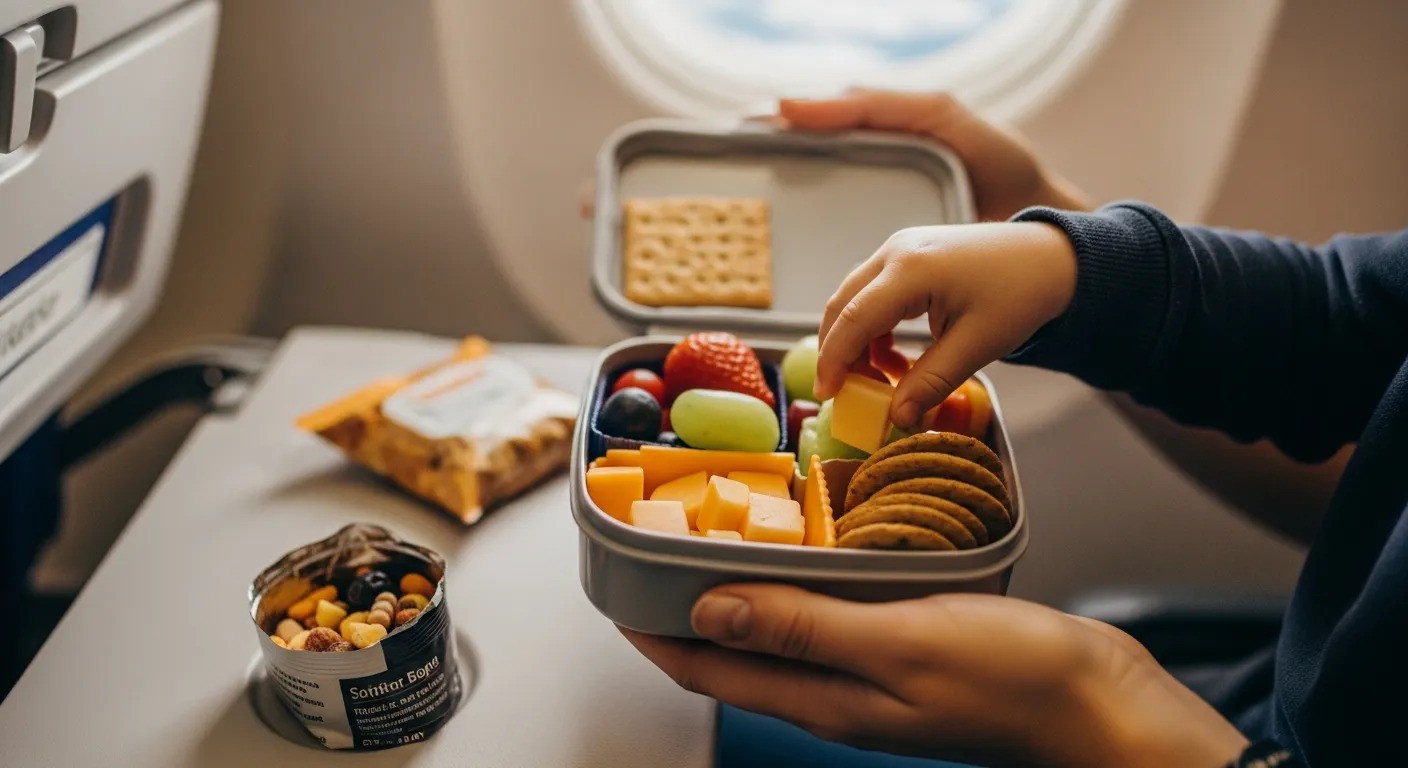
Snacks introduced one at a time at timed intervals function as genuine activity punctuation during a long flight. A parent traveling with a 4-year-old on a 10-hour flight might space snacks across the journey: a bag of Pirate's Booty at the two-hour mark, string cheese at hour four, a small pack of raisins and crackers at hour six, and a treat like a small chocolate at hour eight.
Choosing snacks that require interaction, such as peeling, sorting, or eating piece by piece, extends engagement time further. Avoid high-sugar options in the first half of the flight, as the energy spike followed by a crash creates a difficult window to manage in a confined space.
49. Surprise Goodie Bag With Timed Reveals
The surprise bag is the single most consistently recommended strategy across every category of experienced long-haul family traveler. A parent packs 6 to 8 small items in individual wrapping (tissue paper secured with tape works perfectly) and introduces them one at a time at planned intervals. The unwrapping itself is a 5-minute engagement.
The reveal of an unknown item sustains curiosity for several minutes more. And the activity itself, whether a sticker set, a small figurine, or a mini puzzle, delivers its own engagement window. Items for a goodie bag do not need to be expensive. Dollar store finds, bargain bin toys, and new-to-the-child items from home all work equally well. The novelty is what matters, not the price.
50. Comfort Toy And Pre-sleep Wind-down Ritual
On overnight long-haul flights, the transition to sleep is one of the highest-risk moments for distress, particularly for children aged 2 through 6. Bringing a familiar comfort toy, a favorite small blanket, and maintaining a version of the home bedtime routine (pajamas, a quiet book, low lighting, and a calming audio track) significantly increases the likelihood of a child sleeping for several hours of the flight.
This is not an activity in the entertainment sense but a proactive strategy that covers more flight time than any game or toy on this list. An inflatable footrest, if permitted by the airline, allows smaller children to stretch their legs flat, which supports sleep comfort considerably. Parents should verify footrest policies with their specific carrierbefore travel.
Age-by-Age Guide To The Best Activities From This List
Best Airplane Activities For 2 To 4-Year-Olds
Toddlers at this stage are in a critical period of fine motor development, which means activities that involve peeling, sticking, threading, stacking, and manipulating small objects are naturally engaging because they align with what the brain and hands are already trying to do.
From the list above, the most reliable choices for this age group are window clings, reusable sticker books, water painting books, lacing cards, finger puppets, the suction spinner, pipe cleaners, painter's tape, stackable cups, and magnetic stickmen.
For screen time, Bluey, Peppa Pig, and Cocomelon offline downloads hold this age group better than any other content currently available. The comfort toy and wind-down ritual and staged snack introductions are non-negotiable for this age group on any flight longer than three hours.
Best Airplane Activities For 5 To 7-Year-Olds
Children in this age band have longer attention spans, can follow rules in simple games, and are beginning to enjoy the satisfaction of completing something. Activity books, drawing activities, and entry-level games all fit well here.
The strongest picks from this age group are the sketch pad, water painting books, dry-erase activity books, Crayola Color Wonder sets, printable activity sheets, Kanoodle, the mini Simon game, printable bingo, UNO, Spot It, kids podcasts, and the in-flight entertainment system. Staged snack introductions and the surprise goodie bag remain highly effective for this group.
Best Airplane Activities For 8 To 12-Year-Olds
Older children want activities that feel grown-up and challenging. They are capable of self-directed play for extended periods and respond well to competitive or strategy-based games. They also benefit most from audio content, which frees them from screen dependence on very long routes.
The best picks for this group are Kanoodle Genius, the Rubik's Cube, magnetic chess, brain teaser books, Mad Libs, Cat's Cradle, maze and logic puzzle books, the LCD drawing tablet, the travel journal, origami, audiobooks, downloaded films, educational apps, fun multiplication games, and kids podcasts. The surprise goodie bag works best for this group when items are specifically chosen to feel age-appropriate, including puzzle cards, interesting stationery, or small strategy game additions.
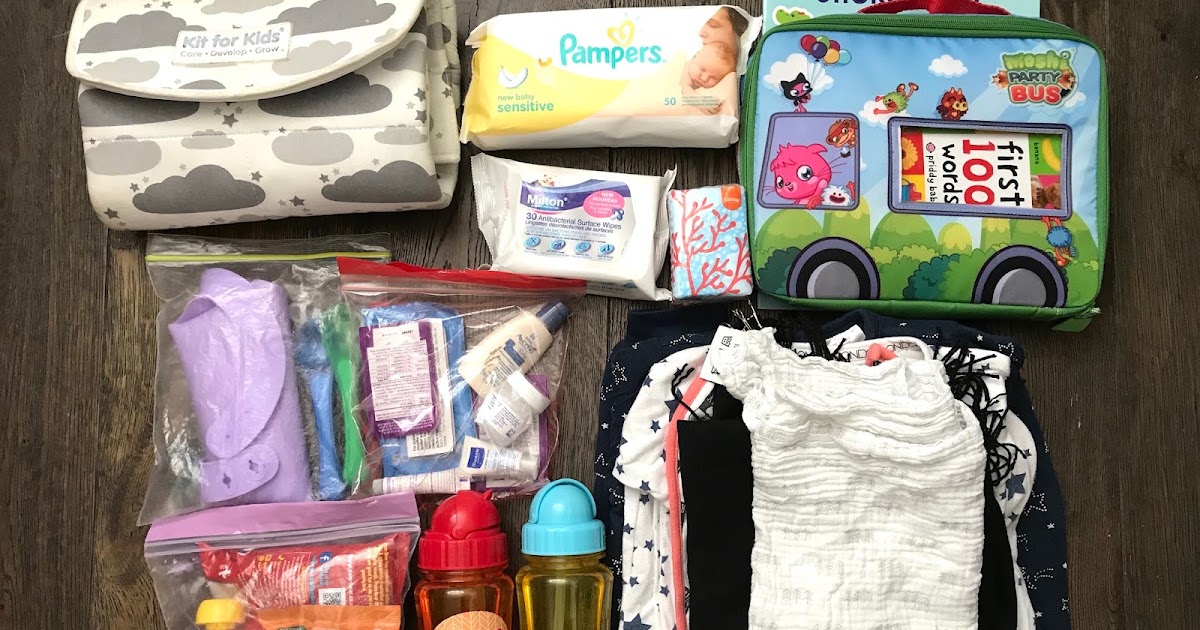
How To Pack For A Long Flight Based On Flight Duration
A parent who packs 15 activities for a 2-hour flight creates clutter and overwhelm. A parent who packs 3 activities for a 12-hour flight runs out of options at hour two. The framework below removes the guesswork.
- Under 3 hours:2 to 3 activities plus snacks. Choose items from the sensory or drawing categories. No need for the surprise bag structure. Keep the pack light and focus on one activity at a time.
- 3 to 7 hours:4 to 6 activities covering at least two categories (for example, one drawing activity, one game, and one audio option). Save the tablet for the second half of the flight. A small snack rotation adds useful punctuation.
- 8 to 14 hours (long-haul and overnight flights):7 to 10 items structured as a timed surprise bag. Plan the reveal schedule loosely before boarding: one item at the 1-hour mark, one at the 2-hour mark, tablet introduced at hour 4, snack break at hour 5, new activity at hour 6, sleep setup beginning at hour 7. This is not a rigid script but a loose plan that gives parents something to work from when tiredness makes improvisation harder.
What To Leave At Home
Some activities that look ideal online fail immediately in the reality of a narrow economy seat. Avoiding them is as important as choosing the right ones.
- Toys with large quantities of tiny loose pieces (most LEGO sets, small bead kits, marble runs) create floor-crawling recovery missions at altitude and risk permanently lost pieces
- Noisy or repetitive sound toys cause conflict with neighboring passengers and contribute to sensory overload for children who are already in an unfamiliar, stimulating environment
- Toys that roll (dice, marbles, small balls) travel the full length of the aisle and under seats when dropped, which happens frequently during turbulence
- Activities requiring a large flat assembly area (floor puzzles, large board games, anything described as needing a "clear surface") simply do not fit on a standard airline tray table
- Activities that require constant adult involvement defeat the purpose of packing entertainment for a child, since parents need to eat, rest, and manage logistics during a long-haul flight
Frequently Asked Questions
What Is The 3-3-3 Rule For Flights?
The 3-3-3 rule is a TSA carry-on liquids guideline. It states that liquid containers must hold 3.4 ounces or less, all containers must fit in one quart-sized clear bag, and each passenger is limited to one such bag. It has no relation to child entertainment strategies and occasionally appears in search results for this topic due to keyword overlap.
What Is The 9-Minute Rule For Kids?
The 9-minute rule is an informal child development concept suggesting that giving a child 9 minutes of focused, undivided parental attention after a transition or overstimulating event helps them settle emotionally before being expected to play independently.
How Should Parents Handle A Mid-flight Tantrum?
Stay calm and resist the urge to worry about other passengers' reactions. Deploy a new snack or an unwrapped surprise item immediately. Whispering rather than raising the voice tends to make a child quieter in response, since they have to be still to hear.
Final Thoughts
No amount of planning guarantees a perfect flight. Children are unpredictable, sleep schedules shift at altitude, and even the most carefully chosen activity will occasionally be rejected on sight. That is normal.
What preparation change is not the flight itself, but the parents' capacity to respond to it. The activities above cover every age, every flight length, and every type of child. The principle connecting all of them is one thing at a time, introduced at the right moment, backed by the patience that only preparation makes possible.
Jump to
What This Article Covers
Why The Rotation Principle Changes Everything
Hands-On Sensory And Sticker Activities
Drawing, Writing, And Creative Activities
Games, Puzzles, And Strategy Activities
Card Games And Group Activities
Audio And Screen Activities
Movement, Observation, And Window Activities
Snack And Comfort Activities
Age-by-Age Guide To The Best Activities From This List
How To Pack For A Long Flight Based On Flight Duration
What To Leave At Home
Frequently Asked Questions
Final Thoughts

Michael Rachal
Author
Michael Rachal believes that luxury lies in the details. With over 20 years of experience in the luxury travel industry, he has crafted hundreds of bespoke itineraries for clients seeking personalized, unforgettable experiences.
Whether guiding clients through private cultural tours or curating culinary journeys with world-renowned chefs, Michael ensures that each trip is tailored to perfection.
His ability to anticipate needs and exceed expectations has earned him a reputation as a leading expert in luxury travel.

Finn Wilde
Reviewer
For Finn Wilde, the wilderness is more than just a destination - it’s a way of life. Over the past decade, he has led multiple expeditions in some of the world’s most remote regions, from the icy fjords of Greenland to the rugged trails of Patagonia.
Finn emphasizes sustainability in all of his adventures, helping participants connect with nature while promoting responsible exploration. His expeditions inspire individuals to explore the great outdoors while fostering a deep respect for the environment.
Latest Articles
Popular Articles